
- Total 0 kr

Professional Sound for Everyone
Professional Sound for Everyone: Roland V31, V51 and V71 Explained
Roland’s V31, V51 and V71 modules introduce a more unified V-Drums structure than we’ve seen before. All three are built on the same modern sound platform—so the core sound quality is shared—while the real differences come down to workflow, editing depth, routing and how far you want to integrate your kit for recording or live use.
Roland V31, V51 and V71: same sound platform – different levels of control
The key takeaway is simple: V31, V51 and V71 share the same sound foundation, which means the starting point for tone, dynamics and response is comparable across the range. Roland’s approach shifts the buying decision away from “Which sounds best?” toward “How much control and connectivity do I need?”
V31: player-focused simplicity
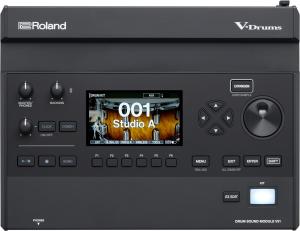
The V31 is designed for immediacy. The workflow is streamlined, the menu depth is intentionally limited, and the emphasis is on ready-to-play kits that sound convincing without extended programming. It’s a practical choice for home drummers, practice setups, teaching environments and anyone who wants flagship sound with minimal complexity.
V51: the balanced middle ground
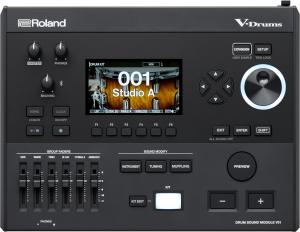
The V51 sits in the sweet spot between simplicity and deeper control. It keeps the same core sound platform as V31, but adds meaningful flexibility for shaping your mix, ambience and response. It’s aimed at drummers who move between home, rehearsal room, basic recording and smaller live contexts—and who want more control without stepping into full flagship complexity.
V71: a professional control center
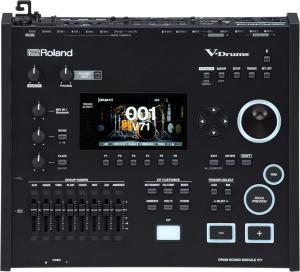
The V71 is built for deeper integration and professional routing. This is where you get extensive output options, multichannel USB audio for serious tracking, and a workflow that supports advanced setups on stage and in the studio. The learning curve is higher, but so is the payoff if you need full control over your signal flow.
Summary: what actually separates them
V31, V51 and V71 illustrate a clear shift: Roland separates models by depth of control and intended use—not by core sound quality. V31 is the most straightforward and play-oriented, V51 adds flexible control without going fully “pro routing,” and V71 is designed for maximum integration and signal management for studio and live.
Features and target user
| Feature | V31 | V51 | V71 |
|---|---|---|---|
| Overall focus | Play & practice focused | All-round with expanded control | Professional control & integration |
| Sound platform | Shared flagship platform | Shared flagship platform | Shared flagship platform |
| Editing depth | Basic | Expanded | Very deep |
| Workflow depth | Low—focused on ready kits | Medium—balance of play and tweaking | High—detailed control of signal flow |
| Routing / signal handling | Fixed stereo workflow | Limited but useful routing options | Advanced, fully routing-oriented |
| Typical user | Home drummer, practice, teaching | Ambitious drummer, band, semi-pro | Professional studio/live, touring |
| One-line summary | Same sound, least hassle | Same sound, more control | Same sound, full control |
Inputs (pads, triggers and digital pads)
| Input type | V31 | V51 | V71 |
|---|---|---|---|
| Standard kit via DB-25 harness (one physical connector) |
1× DB-25 harness for: Kick, Snare, Tom1, Tom2, Tom3, Hi-hat, Crash1, Ride, Ride Bell, Hi-Hat Control
Note: exclusive use (cannot be used simultaneously with digital pad) |
1× DB-25 harness for: Kick, Snare, Tom1, Tom2, Tom3, Hi-hat, Crash1, Ride, Ride Bell, Hi-Hat Control
Note: exclusive use (cannot be used simultaneously with digital pad) |
No DB-25 harness input (uses separate analog TRS inputs) |
| Additional analog trigger inputs (separate 1/4" TRS jacks) | 2× 1/4" TRS: CRASH 2, AUX/TOM 4 | 4× 1/4" TRS: CRASH 2, AUX 1/TOM 4, AUX 2, AUX 3 | 14× 1/4" TRS analog trigger inputs (exclusive use with digital pads) |
| Digital trigger inputs (USB-A) | 1× DIGITAL TRIGGER IN (USB-A) | 3× DIGITAL TRIGGER IN (USB-A) | 3× DIGITAL TRIGGER IN (USB-A, high-speed) |
| Mix input (for external playback device) | 1× MIX IN (stereo, 3.5 mm) | 1× MIX IN (stereo, 1/4") | 1× MIX IN (stereo, 1/4") |
Note (V31/V51): The DB-25 connection is a single physical connector that breaks out to multiple pads via a harness. The extra 1/4" TRS inputs are separate physical jacks intended for expansion.
Outputs and connectivity (audio, MIDI, USB, headphones)
| Output / connection | V31 | V51 | V71 |
|---|---|---|---|
| Main outputs | MASTER OUT L/MONO, R: 2× 1/4" TRS (unbalanced) | MASTER OUT L/MONO, R: 2× 1/4" TRS (unbalanced) | MASTER OUT (balanced): 2× XLR (L, R) + 2× 1/4" (L/MONO, R) |
| Direct outputs | None | 2× DIRECT OUT: 1/4" TRS (unbalanced) | 8× DIRECT OUT: 1/4" TRS (balanced) |
| Headphones | 1× PHONES (3.5 mm) | 2× PHONES (1/4" + 3.5 mm) | 2× PHONES (1/4" + 3.5 mm) |
| MIDI (DIN) | MIDI OUT | MIDI IN + OUT/THRU | MIDI IN + OUT/THRU |
| USB to computer | USB-C (Audio + MIDI) | USB-C (Audio + MIDI) | USB-C (Audio + MIDI) |
| USB audio channels (Vendor mode) | Record: 30 ch / Playback: 32 ch | Record: 32 ch / Playback: 32 ch | Record: 32 ch / Playback: 32 ch |
| Bluetooth | Bluetooth audio/MIDI | Bluetooth audio/MIDI | Bluetooth audio/MIDI |
FAQ – Roland V31, V51 and V71
Do V31, V51 and V71 have the same sound quality?
Yes. All three modules share the same core sound platform, so the baseline sound, dynamics and response are comparable. The differences are about control, routing and connectivity.
Is the V31 a “lower quality” module?
No. The V31 isn’t lower quality—it's more streamlined. You get flagship sound with fewer parameters and a simpler workflow.
What is the main difference between V31 and V51?
The V51 provides more flexibility: more analog expansion inputs, more digital trigger inputs, additional outputs and a workflow that supports deeper shaping and broader use cases.
Do all three modules support the same pads?
Yes. They support the same analog Roland pads. The key differences are how the module can route audio, handle outputs and integrate with recording/live systems.
How many trigger inputs does the V31 have?
The V31 includes one DB-25 harness connection for Kick, Snare, Tom1–Tom3, Hi-hat, Crash1, Ride, Ride Bell and Hi-Hat Control, plus two additional 1/4" TRS trigger inputs (Crash 2 and AUX/Tom 4), and one USB-A digital trigger input.
What does the DB-25 harness connection mean?
It’s a single physical connector that breaks out into multiple trigger connections via a harness. It keeps standard kit wiring clean and quick.
What most clearly separates the V71 from V31 and V51?
V71 is built for professional integration: balanced main outputs, eight balanced direct outputs, 14 analog trigger inputs, three high-speed digital trigger inputs and full multichannel USB audio routing.
Do I need the V71 for home practice?
Usually not. For home use, V31 or V51 is typically the best fit. V71 becomes relevant when you need advanced routing, separate outputs and deeper studio/live integration.
Is the V51 a good middle ground?
Yes. The V51 is a deliberate balance: the same sound platform with expanded control and connectivity—without the full flagship routing scope of the V71.
Which module should I choose?
Choose V31 if you want the simplest flagship-sound workflow, V51 if you want more control and room to grow, and V71 if you need maximum routing, separate outputs and professional studio/live integration.
Related products
-

Roland V‑31 - V‑Drums Sound Module
V-Drums sound module from Roland built on the V71 engine, bringing flagship sound to a compact module. USB-C, Bluetooth and SD recording.
V31
11 666 kr / pc.12 310 kr / pc.Save 5 %- Stock status
- In stock
-

Roland V-51
Roland V-51 sound module, 5 Series, bringing the V71 engine's sound with fast control. USB-C, Bluetooth, 4.3" color screen.
V51
20 890 kr / pc.23 190 kr / pc.Save 10 %- Stock status
- In stock
Earlier posts
-

New Roland TD-07KV2 and TD-07DMK2 – Updated V-Drums for Home Practice
Roland updates the TD-07 series with two complete, compact V-Drums kits featuring improved pads, easier assembly, and more ways to develop your playin...
-

Pearl turns 80: find a Gold Ticket in your new stand
Pearl turns 80 and is celebrating with a ticket hunt across Europe. Winning Gold, Silver and Bronze tickets are hidden inside the packaging of seven o...
-

Lowered Prices on Seven Pearl Classics
-

New from TAMA on 1 September: Starclassic finishes, limited snares and lightweight stands